Case study
Never Ignore DMARC: How We Detected and Neutralized a 60k API Abuse Event
Contained a 60,000+ message API abuse event, with zero persistence and core production workloads preserved.
Outcomes
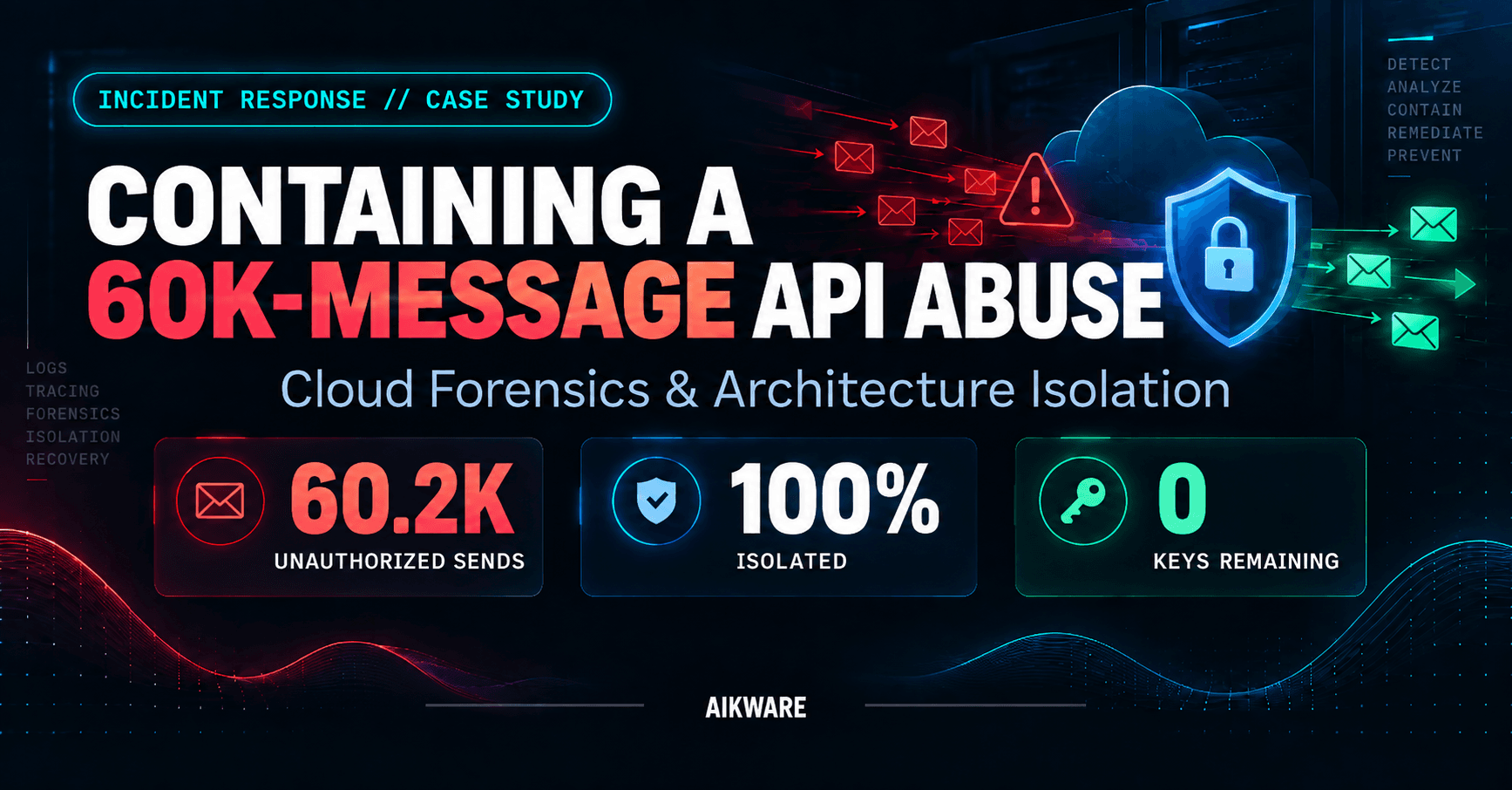
- 60,232 unauthorized messages identified and blast surface proven across secondary connected domains
- 100% isolation of unauthorized sending capacity via domain disablement and credential revocation
- Zero active API keys remaining on the shared provider after immediate revocation
- Email pipeline re-architected to domain-scoped, least-privilege keys per application environment
The situation
When unauthorized outbound traffic threatens domain health and burns email service quotas, precision engineering and forensics are needed. An automated 60,000+ message API abuse event on a shared transactional mail account exhausted monthly quota, damaged domain reputation risk, and blocked legitimate production sends with downstream 429 rate limits.
What we did
We correlated DMARC aggregate telemetry with outbound provider metrics, then ran a multi-vector forensic audit across provider API logs, AWS CloudWatch, host integrity checks, and secret-surface mapping. Containment revoked all active API keys, disabled affected domains, suppressed blast recipients, and re-architected outbound mail to domain-scoped least-privilege keys with hardened AI tooling and secret governance.
When unauthorized outbound traffic threatens domain health and burns email service quotas, precision engineering and forensics are needed.
This is how our engineering team identified, analyzed, and contained an automated 60,000+ message API abuse event, ensuring zero persistence and reassuring core production workloads.
The Trigger: DMARC Telemetry and Anomaly Detection
Our investigation began with a routine review of an automated DMARC report.
- The telemetry signal: Analysis of provider DMARC aggregate (rua) reports revealed abnormal SPF alignment failures caused by heavy mail forwarding through intermediate third-party relays.
- The correlation: While DKIM initially passed and DMARC disposition remained neutral (p=none), the routing pattern was irregular for expected transactional traffic.
- The finding: Cross-referencing these reports against outbound provider metrics exposed ~20,000 unexpected messages on a single secondary domain carrying third-party phishing templates and unverified redirect URLs. A wider audit quickly revealed total unauthorized volume exceeding 60,200 messages.
The Challenge: Detection and Impact Recognition
During a high-throughput outbound sending incident, an external threat actor leveraged an API key on a shared transactional mail account to launch an unauthorized phishing blast:
- Blast volume: 60,232 unauthorized messages dispatched in an afternoon across secondary connected domains.
- Immediate risk: Monthly quota exhaustion, severe domain reputation damage, and immediate downstream rate-limiting (429 Too Many Requests).
- Operational impact: Legitimate production transactional messages began failing due to provider quota limits immediately following the blast.
The Investigation: Evidence-Based Forensics
Rather than applying guesswork, we performed a multi-vector cross-telemetry audit across cloud logs, provider metrics, and developer environments to prove the exact blast surface:
- Traffic signature fingerprinting: Traced provider API logs to confirm traffic targeted single POST /emails endpoints rather than batch methods. Identified the distinct client signature (Python/3.13 aiohttp/3.14.3 / custom bulk sender user-agents), which helped isolate the phishing payload.
- Eliminating application vulnerabilities: Audited our web application’s serverless compute and SSR log groups in AWS CloudWatch. Verified that our production forms exclusively route through batch endpoints and isolated domains, ruling out an application-level injection. Validated zero unauthorized execution events across background workers and scheduled lambdas during the attack window.
- Host-level integrity verification: Audited developer host system journals, active accounts, SSH sessions, cron jobs, and Python runtime environments. Confirmed zero runtime matches or active host compromises during the attack timeframe.
- Secret surface exposure mapping: Scanned repository histories and verified zero committed API credentials across version control. Evaluated cloud parameter stores (AWS Systems Manager) and identified potential exposure vectors within AI-assisted development tools where strict data-retention settings were disabled.
Containment and Long-Term Hardening
- Instant credential revocation: Invalidated all active API keys across the shared provider immediately, bringing active secrets to zero.
- Blast containment: Disabled outbound sending across affected domains and executed batch recipient suppression to mitigate spam complaints.
- Architectural isolation: Re-architected our email pipeline away from shared credentials to strictly domain-scoped, least privilege API keys isolated per application environment.
- AI tooling and secret governance: Hardened internal development policies to mandate local zero-retention privacy modes and automated secret scanning safeguards across all tooling.
What This Means for Our Clients and Partners
Security and reliability are active operational practices. By combining deep cloud forensics with rapid incident response, we resolve vulnerabilities at the root cause. This allows us to protect critical domain reputations while ensuring business continuity across modern cloud architectures.
Facing unauthorized API abuse, domain reputation risk, or a compromised transactional mail pipeline? We can discuss cloud forensics, incident containment, and least-privilege architecture hardening.